Cart
Cart
Motorcycle Accident Fault for Illinois Motorcyclists
Last updated Monday, August 17th, 2026
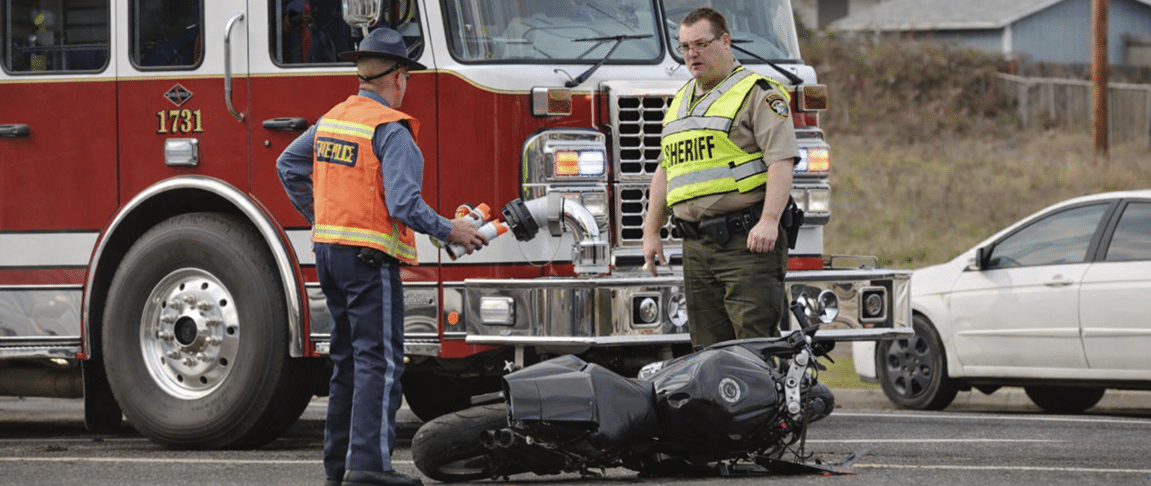
Motorcycle accidents in Illinois can typically result in the injured party having to prove who was at fault for the accident, which is essential for obtaining any possible recovery from an insurance company and to determine what type and amount of recovery (i.e., compensation) is available.
In Illinois, we have a “modified comparative negligence” system. The amount of your recovery (damages) will be reduced based on the percentage of fault assigned to you. Therefore, you can still recover damages if you are 50% or less at fault. Your damages are reduced by your percentage of fault. If you are more than 50% at fault, such as 51%, you cannot recover.
There are many factors as to why motorcycle riders might experience challenges when attempting to dispute liability/fault. For example, because motorcycle riders are typically exposed, they tend to suffer severe injuries/death after even a minor vehicle-to-vehicle accident where only minimal property damage has occurred. Motorcyclists also may encounter negative stereotypes which affect both insurers’ initial evaluation of their claim and/or jurors’ perception of the incident(s).
Therefore, it is beneficial for Illinois motorcycle riders to understand how comparative fault operates prior to needing this knowledge.
Have You Been Injured in a Motorcycle Accident?
If you need a motorcycle accident lawyer, talk to an experienced lawyer who’s been helping injured bikers for over 40 years.
Understanding Comparative Fault Systems
There are different methods that states utilize in order to assign liability in accidents. The most commonly utilized methods include:
| System | General Examples | May the claimant recover? | General rule |
| Pure comparative negligence | California and New York | Yes, regardless of percentage | Damages are reduced by the claimant’s percentage of fault. |
| Modified comparative negligence, recovery through 50 percent | Illinois and Texas; Florida for most current negligence actions | Yes, when fault is 50 percent or less | Fault greater than 50 percent bars recovery. |
| Modified comparative negligence, recovery below 50 percent | Colorado | Yes, when the claimant’s fault remains below the applicable threshold | Fault at the threshold can bar recovery. |
| Contributory negligence | Alabama, Maryland, Virginia, North Carolina, and the District of Columbia | Generally only when the claimant has no legally contributing negligence | Contributing negligence can bar recovery. |
Illinois permits an injured plaintiff to recover when the plaintiff’s fault is 50 percent or less. Any award is reduced in proportion to the plaintiff’s fault. To avoid any reduction, the plaintiff must be found free of fault.
Illinois Statute Regarding Comparative Fault
Section 2-1116 of the Illinois Code of Civil Procedure governs comparative fault in negligence and strict product liability actions involving bodily injury, death, or physical damage to property. In both bench trials and jury trials, it is up to either the judge/jury to determine how much of the claimant’s total damages will be attributed to the claimant’s own negligence/comparative fault.
For example, let us assume a jury awards a motorcyclist who was injured in a motorcycle accident $150,000 in damages prior to any potential reductions due to comparative fault.
- The motorcyclist has 20% comparative fault; therefore, his/ her award would be reduced by $30,000. He/she would receive $120,000.
- The motorcyclist has 49% comparative fault; therefore, he/she would have their award reduced by $73,500. Therefore, he/she would receive $76,500.
- The motorcyclist has 50% comparative fault; therefore, he/she would receive only 50% of what he would otherwise collect. Therefore, he/she would collect $75,000.
- The motorcyclist has 51% comparative fault; therefore, he/she would be prohibited from collecting damages at all.
Jurors do not simply pull numbers out of thin air when assigning percentages. Rather, they consider testimony, photos/video, physical evidence, applicable traffic laws, and other relevant evidence to help them decide if one or more parties acted reasonably during the event(s) leading to the accident/injuries.
Determining Liability Through Evidence in Motorcycle Accidents
Documentation and Evidence Collection
Police reports (and other documentation prepared by law enforcement) typically represent one of the first documents generated subsequent to an incident. Police reports may contain documented statements of individuals involved, road conditions, locations of vehicles at the time of contact, citations issued, and/or observations made by the officer(s). Although a police report provides important documentation of an incident, it does not constitute conclusive proof of civil liability. Portions of a police report may be disputed or found to be inadmissible into evidence based upon the specific circumstances. An attorney can assist in investigating the accuracy or completeness of certain statements or conclusions contained within a police report.
Witnesses who were independent observers of the incident are particularly valuable where there is no personal stake in the results of litigation related to the incident.
Video from various types of sources including traffic cameras, business/ residential security cameras, helmet-mounted cameras and motorcycle cameras may assist in establishing the sequence of events. Therefore, preservation requests for video records should be submitted as soon as possible since many systems automatically purge their records shortly after recording.
Documentation of physical evidence such as roadway markings, debris fields, vehicle damage, and final resting places of vehicles will enable qualified reconstruction experts to determine factors such as speed, deceleration, direction of travel, and the order of events prior to the occurrence of the impact.
Some new motorcycles now come equipped with electronic memory devices which may record speed, deceleration, etc. Similarly, route tracking applications and smartphone data may provide additional relevant evidence; however, each type of evidence must meet required standards for authenticity and admissibility before it may be presented during trial.
Factors That May Affect Fault and Insurance Issues
Factors that may affect how fault is evaluated in a motorcycle accident include:
- Speed
- Lane position and lane usage
- Use of turn signals
- Traffic violations
- Weather and road conditions
- Alcohol or drug impairment
- Vehicle or motorcycle mechanical failure
- Reaction time and the ability to avoid the collision
Prejudice Against Motorcyclists
There are many people who believe motorcyclists ride recklessly just because they ride a motorcycle. Therefore, your trial should focus on what can be proven rather than relying on stereotypes as fact. Evidence that is typically used to show that a motorcyclist was in fact riding safely could include such things as speed limits were followed, signals were used properly, he or she rode in an appropriate position within the lane of traffic, had legal safety equipment, there is eyewitness testimony from other vehicles involved, and if so, then there may be video evidence from cameras that will be available to support their claim.
Challenges for Motorcycle Riders in Illinois
Helmet Use and Liability

Although Illinois courts have previously refused to allow a jury to consider whether a rider’s lack of wearing a helmet might contribute to their comparative negligence or diminish a judgment award, in Hukill v. DiGregorio, the Illinois Appellate Court applied Clarkson’s reasoning to motorcycle helmet non-use (Illinois Supreme Court in Clarkson v. Wright); i.e., helmet non-use will not be considered as comparative negligence nor for purposes of mitigation.
However, it is possible that an insurance company may still reference helmet usage during settlement negotiations; however, helmet non-usage should never be represented as a legitimate amount of comparative fault in accordance with present-day Illinois case law. Therefore, proper fitting and use of helmets and other forms of protective gear are highly recommended for increased safety.
Lane Positioning and Filtering
Lane splitting/filtering (riding in between lanes) is illegal in Illinois. Should an injured motorcyclist be traveling between two cars at the time of impact for his injuries, the insurance company/defendant may make an argument that the motorcyclist’s actions caused/contributed to the accident. A traffic violation does not mean a rider will always be found liable for the accident/civil fault; however, it should be viewed as one piece of evidence in conjunction with all the rest, and that there must be some causation by the rider’s actions that resulted in either the accident or injury.
Road Hazards and Government Liability
Potholes, loose gravel, construction debris, defective markings, and other roadway conditions may contribute to motorcycle crashes. Depending on who controlled the roadway and the surrounding facts, a local public entity, the State, a contractor, or another party may potentially be liable.
For a claim involving property controlled by a local public entity, Illinois law generally requires proof that the entity had actual or constructive notice of an unsafe condition in reasonably adequate time to remedy or protect against it. Statutory immunities may also apply.
Illinois does not impose a general six-month notice requirement for personal injury claims against cities and counties. Most civil actions against an Illinois local public entity or its employee must be commenced within one year.
Claims against the State of Illinois or an agency such as the Illinois Department of Transportation generally proceed in the Illinois Court of Claims. A claimant generally must provide the statutory notice within one year unless the Court of Claims action itself is filed within that year. Most such claims must be filed within two years, although exceptions may apply.
Defective Products
It is critical that you preserve the motorcycle and all potentially defective components as they are. Any repairs, destruction, alteration, or disposal could result in loss of necessary evidence for evaluating a product liability claim. A defect in one or more brake, tire, or steering component(s) or some other part of the motorcycle could be an unsafe condition that could have contributed to the motorcycle crash.
Have You Been Injured in a Motorcycle Accident?
If you need a motorcycle accident lawyer, talk to an experienced lawyer who’s been helping injured bikers for over 40 years.
How Comparative Negligence Affects Damages
The hypothetical examples listed below are based on real evidence, but actual percentage values will vary depending upon your individual case.
Example 1: Motorcycle Riders, Motor Vehicle Drivers and Cross Traffic
An automobile driver makes a left turn across the path of a motorcycle rider that was speeding (the rider’s speed exceeded the posted speed limit). The jury finds that the driver bears 80% of the responsibility for the accident and the motorcycle rider bears 20%. If the total damages for this incident are valued at $100,000, the motorcycle rider can expect to receive $80,000.
Example 2: Distracted Automobile Driver Runs Red Light / Stop Sign
A motorcycle rider obeys all traffic regulations, and the distracted automobile driver runs through a red light/stop sign, striking the motorcycle rider. The jury finds that the automobile driver bears 100% of the fault for causing the accident. If the total damages for this incident are estimated to be $200,000, then the motorcycle rider may collect the entire amount ($200,000).
Example 3: Motorcycle Rider Cuts Off Automobile Driver by Changing Lanes Without Using Turn Signal; Automobile Driver Was Distracted Before Accident Occurred
A motorcycle rider cuts off an automobile driver by changing lanes without using a turn signal. An automobile driver becomes distracted before he strikes the rear of the motorcycle rider. The jury finds that the automobile driver bore 85% of the responsibility for this accident and the motorcycle rider bore 15%. Total damages for this incident were estimated to be $500,000. Therefore, the motorcycle rider would have his damages reduced by $75,000. As such, the motorcycle rider could potentially expect to obtain a damages award of approximately $425,000.
Insurance Companies and Comparative Fault
Insurance adjusters/investigators deal with claims all of the time and could potentially ask you questions that will get you to tell them how fast you were going, how well you could see, where you were at the time of the collision, or how quickly you reacted. When you give a detective a statement (like “I didn’t see the car”) or say something like “I may have gone a little too fast”, they can use it against you in court.
Try to be cautious of making assumptions or admitting fault for the accident until you have found out what really happened. In addition, if you apologize for what happened, depending upon the way that it was worded and the circumstances surrounding it, it can possibly be used by an attorney to show that you admitted fault.
In general, you do not need to make a recorded statement to another person’s liability insurance company. If possible, speak with an attorney before making one. Depending on the terms of your own insurance contract, there could be some obligation to cooperate with your own insurance carrier; therefore, communicate with your insurance carrier in a manner consistent with your policy, and with legal advice as necessary.
If the at-fault driver is uninsured, or if the applicable liability limits are lower than the UIM limits available to you, UM or UIM coverage under an applicable policy may become relevant. Contact your insurance provider. It is also important to note that comparative negligence applies here as well since most Uninsured/Underinsured coverage is based on damages that you would be able to collect from the uninsured/underinsured driver.
Follow the Proper Protocol Following a Wreck
Under Illinois law, an injured motorcyclist may recover damages if they were no more than fifty percent responsible for the injury. If you are a motorcycle driver who has been involved in an accident that was caused by someone else, and your responsibility for being hurt is no greater than fifty percent, your damages will be calculated based on how much you were responsible for the accident. If you were more than fifty percent responsible for your injury, then you cannot recover anything from the other party.
If you have been involved in a motorcycle accident, it would be helpful to seek immediate medical treatment. It is also helpful to save as many physical objects and photographs as possible because this can help prove the extent of the damage. It is unwise to guess at what happened; instead, contact an attorney immediately so that he/she can investigate the circumstances of the accident and assess your ability to receive compensation. Additionally, do not let an insurance company’s preliminary assessment of the damages constitute a complete examination of all aspects of your injury.
The attorneys at Motorcycle Safety Lawyers represent injured motorcycle drivers in accidents throughout Illinois. Please call us today at (888) 500-9000 to speak with one of our experienced attorneys. Keep in mind every case is unique and past results are not indicative of future outcomes or results.
[FAQ]
Have You Been Injured in a Motorcycle Accident?
If you need a motorcycle accident lawyer, talk to an experienced lawyer who’s been helping injured bikers for over 40 years.